Will There Ever Be a Draft Again
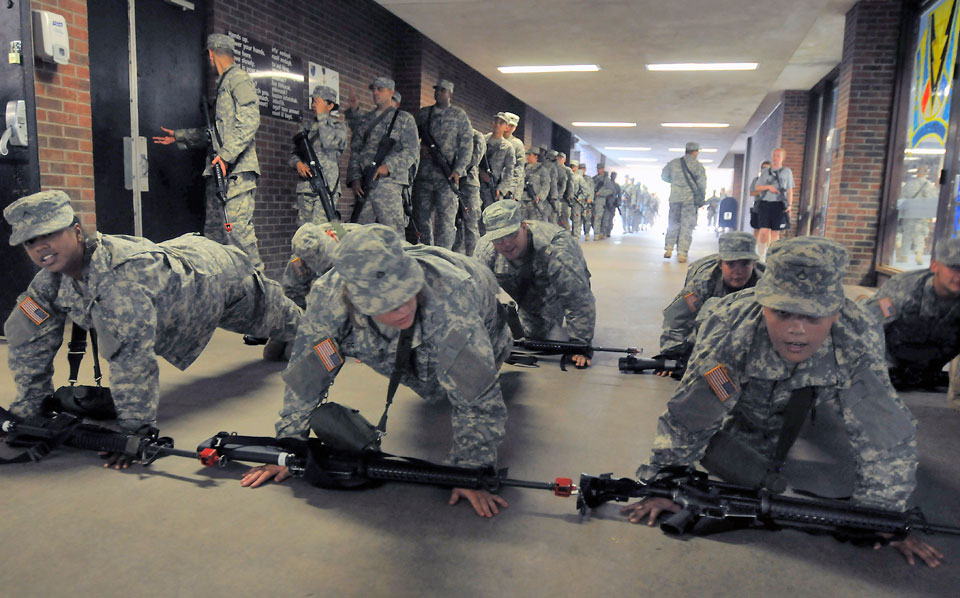
New Army recruits become through their drills exterior of the mess hall at Fort Jackson in Columbia, S.C. | T. Ortega Gaines / The Charlotte Observer via AP
Congress has once again deferred making a decision as to whether to finally terminate draft registration or to aggrandize information technology to include young women every bit well equally young men.
The final version of this year's almanac National Defence force [sic] Authorization Act (NDAA) canonical past Congress on December 14th and signed into police force on December 27th by President Biden makes no alter to the provisions of the Military Selective Service Act (MSSA) which authorize the president to order men, but not women, to register with the Selective Service System (SSS) for a possible armed services typhoon. This leaves the current Selective Service registration and accost reporting requirements (applicable to young men just not women) in issue, and the issue unresolved.
Earlier this year, both the Firm and Senate Armed Services Committees voted, without debate or hearings on Selective Service, to recommend that the Fiscal Twelvemonth 2022 NDAA include a department that would have expanded typhoon registration to women. A version of the NDAA including this provision was approved by the total House of Representatives (without a floor vote on whatsoever of the proposed amendments related to Selective Service), and was on the verge of approval in the Senate.
However, in the confront of a deadlock in the Senate over this and other provisions of the NDAA, House and Senate leaders worked out a back-room package of compromises that included removing the section of the FY 2022 NDAA that would have expanded draft registration to women.
The but provisions related to Selective Service that remain in the final version of the NDAA lodge more studies and reports to Congress by the Department of Defense nigh Selective Service and mobilization options. This tends to ostend that Congress has just punted, not abandoned the question, and expects to revisit it.
Democrats may promise to bring the future of Selective Service upwards again in 2022, while they withal narrowly control the House and Senate. Republicans may prefer to put it off until 2023 when they expect to have regained control of Congress. Both Rep. Jackie Speier, D-Calif., Chair of the Military Personnel Subcommittee of the Firm Armed Services Commission and a leading proponent of expanding Selective Service to women, and Rep. Peter DeFazio, D-Ore., the leading sponsor in the House of the Selective Service Repeal Act, take announced that they don't plan to run for reelection in 2022, which may influence whether this is considered before or later on the 2022 elections. Just the outcome won't become away.
Where does this leave typhoon registration and contingency planning for a typhoon?
A proclamation by President Jimmy Carter, issued in 1980, requires men to annals with the SSS within 30 days of their 18th birthday, and written report to the SSS, within 10 days, every time they change their address until their 26th birthday. Few immature men fully or voluntarily comply, and enforcement was abandoned in failure decades ago, but this presidential gild and the law authorizing it remain on the books. Congress and armed services planners continue to pretend that a typhoon based on the current incomplete and inaccurate Selective Service registration database remains a realistic "fallback" option for the Pentagon.
What's on the table for Congress in 2022-2023?
At that place are 3 main options on the table, with a fourth as a wild card. Congress could decide to:
Maintain the status quo, requiring men simply non women to register for the draft, at least unless and until another lawsuit works its way up to the Supreme Court, the Supreme Courtroom chooses to hear it, and the Court rules that requiring men but non women to annals is unconstitutional. This is the option preferred by many pro-war sexists, but some of them are wavering: Nakedly sexist legal obligations and criminal penalties are only also manifestly discriminatory to defend forever.
Attempt to expand Selective Service registration and contingency planning for a draft to women every bit well as men. This seemed an obvious and relatively easy manner out for many liberals and moderates, just support for this option likewise appears to exist softening in the face of objections both applied (few men comply with the registration and accost reporting requirements, and there is no program for how to force unwilling women to comply) and political (members of Congress, including the "liberals" who have been leading the push to expand registration, don't really want to be held answerable at the polls for making martyrs of immature women who refuse to register for the draft, as will be necessary if whatever attempt is fabricated to enforce an expanded registration requirement).
Repeal the MSSA entirely and end draft registration. This choice is winning increasing and bipartisan back up from those whose first choice is ane of the options to a higher place, just who see this as the second-best culling. Repealing the President'south say-so to order anyone to annals for a possible draft, and ending contingency planning for a (male-just) typhoon, is the simply way to end the naked sexism of the electric current male-only draft registration requirement without threatening to "Draft Our Daughters" (and without having to try to enforce draft registration or its expansion to women as well as men).
Append draft registration and put the SSS into standby as information technology was from 1975-80. This is nigh nobody's kickoff preference, but might be put forward as a compromise. At that place's a complexity, though: If the SSS is to continue contingency planning for a draft, even on a "standby" basis, Congress will need to decide whether those plans and preparations should be for a typhoon of men just or of both men and women. And then the repeal of the MSSA (the tertiary pick above) may actually be the most widely acceptable compromise.
Congress doesn't make multiple-choice decisions by ranked-choice voting, so the outcome may depend on how the questions are presented.
How volition Congress handle this issue in 2022-23?
In response to the Congressional leadership compromise over this year'south NDAA, which punts this decision into 2022 or 2023, there has been talk from all sides of the possibility of hearings and consideration of legislation on Selective Service through standalone bills rather than as part of the NDAA. Standalone bills either to repeal the Armed forces Selective Service Act or aggrandize it to women are already pending in Congress, although none of them have received a hearing.
Post-obit enactment of the NDAA, Sen. Kirsten Gillibrand (D-N.Y.), one of the leading advocates on the Senate Armed Service Committee for expanding typhoon registration to women, told NPR that she'll "proceed to pursue 'all legislative routes to implement this policy' through annual defense spending or a standalone beak."
That aforementioned day, Elaine Donnelly of the pro-military machine Center for War machine Readiness, an outspoken opponent of expanding typhoon registration to women, wrote that "Adjacent fourth dimension, whatsoever proposal regarding Selective Service should exist debated in the open up, after total hearings with independent witnesses, in a stand up-lone bill in regular order."
These are positive developments for opponents of the draft and draft registration. Hearings on standalone bills brand repeal of Selective Service more than likely than consideration of the issue as part of the massive multi-issue NDAA without split hearings on Selective Service.
A coalition of anti-war and anti-draft activists has already called on Congress "to give this outcome the full consideration it warrants, by holding a full and fair hearing on this event that considers both policy options before Congress—either catastrophe Selective Service registration or expanding it to women—and that hears from witnesses in support of each of those options."
Consideration of standalone legislation on Selective Service, rather than bundling this result into a future year's NDAA, would allow for more thorough fence. It would also force members of Congress to go on record, for the first time in years, with a separate roll-call vote on this issue. Some members of both the Firm and the Senate voted against the entire 2,000+ page NDAA, but none of those votes could be attributed specifically to what the nib did or didn't say about Selective Service. Most members of Congress accept withal to take whatsoever public position with respect to Selective Service—and don't want to, fearing that whatever they do will anger some of their constituents. That fear is, to some degree, well founded. Merely support for a draft is quite weak, and ending draft registration entirely ("Door Number 3") may exist the position that will prompt the least backlash from voters.
Hearings are as well likely to shift the argue in favor of ending draft registration, as long as independent witnesses supporting both repeal and expansion of Selective Service are invited to testify. The Selective Service emperor has no wearing apparel. When even the former Director of the Selective Service Organization has testified that noncompliance has made the Selective Service database and then incomplete and inaccurate as to be "less than useless" for an actual draft, it should be clear that the Potemkin "mobilization adequacy" purportedly provided past draft registration will non withstand critical scrutiny. Whatsoever full and fair hearing volition telephone call attention to the possibility of repeal and farther expose the failure of typhoon registration, the impossibility of enforcing it, and the pointlessness of standing it, much less trying to expand it to women.
Meanwhile, in country legislatures
Such express compliance with the registration requirement as the Selective Service System currently obtains depends near entirely on state laws that link Selective Service registration to the issuance of drivers' licenses. This is true for young men today, and will as well exist true for young women if the registration requirement is expanded. These state drivers' license laws take go fifty-fifty more than critical since the requirement to register with the SSS in order to be eligible for federal pupil aid was ended by Congress a year ago and that modify took effect in August of this yr.
The problem for the SSS is that (ane) not all states have such laws (populous states with no such laws include California, Pennsylvania, New Jersey, Massachusetts, and Oregon), (2) in most of united states that do take such laws, they use gendered language that makes them apply only to men, and will be vulnerable to challenge, unless amended state by state to apply also to women, if federal police is changed to require women as well every bit men to register with the SSS, and (iii) many of the same state legislators who were virtually willing to press their state motor vehicle codes to sign upward young men for the draft may be least willing to use those aforementioned laws to force young women to sign up to be drafted, a trouble that was predictable by the National Committee on Military, National, and Public Service (NCMNPS) in closed-door discussions disclosed only long afterward in response to my Liberty of Information Act requests.
So the highest current priority for the SSS, consequent with the longstanding state lobbying programme disclosed in response to another FOIA request, is to persuade country legislators (1) to enact such laws in states without them (a pecker for this purpose, H. 4263 / S. 2585, is already awaiting in Massachusetts), and (2) to amend gendered state laws linking Selective Service registration to drivers' licenses to employ non-gendered language, and then that they will remain valid if Selective Service registration is expanded to women.
This ongoing state-by-state legislative activeness will continue in parallel with the ongoing Congressional debate over whether to terminate draft registration or try to expand it to women. These debates virtually the use of country laws to get young people to register for the draft are not a mere footnote to the Congressional contend about federal constabulary: If states won't use their drivers' license laws to pressure immature people to register, the federal government—which abased enforcement of the criminal penalties for refusal to register with Selective Service decades ago—has no "plan B" for enforcement of registration. Monitoring and opposing proposals in their state legislatures for new or expanded linkages between drivers' licenses and draft registration, and working to repeal existing country laws related to Selective Service to preempt any attempt to expand them, should be a priority this yr for opponents of the typhoon and draft registration.
What else can opponents of the draft, registration, and the unpopular wars they enable practise?
Don't wait. The time to organize against the draft and typhoon registration is at present.
Consciousness raising is the first step. Spread the word to everyone you know, particularly immature women. Virtually people have no thought that in that location is ongoing planning and preparation for military conscription in the U.S., that x 1000 members of draft boards covering every county in the U.S. have been appointed and trained to administrate a future draft, that applicants for learners' permits or drivers' licenses as immature equally 15 years old in some states are existence signed up to kill or be killed on control (still U.S. authorities crocodile tears about the conscription of "kid soldiers" in other countries), or that Congress is on the verge of a decision as to whether to end all of this or to try to expand it to young women.
Urge your state legislators to repeal, non expand, state laws linking Selective Service registration to drivers' licenses. Urge your U.S. Representative and U.S. Senators to (one) cosponsor the Selective Service Repeal Human action (H.R. 2509 / Due south. 1139) and (2) push button for full and fair hearings on this pecker, with independent nongovernmental witnesses, in the House and Senate Armed Services Committees. Information technology's especially critical to get members of both Military Committees to support this pecker and the call for a total hearing on it, which no member of either Armed Service Commission has all the same washed. There'south a phone script and an electronic mail form you can use to contact Congress. Or yous tin send your ain message.
Put Representatives and Senators on the spot by request questions at boondocks halls and other events: Practice they believe that young women (or young men) who decline to hold to fight any futurity war that not enough people are willing to volunteer to fight should exist put in prison house? If not, why aren't they a cosponsor of, and calling for a hearing on, the Selective Service Repeal Deed? Don't let them off with a facile answer of "Because equality." As opponents of typhoon registration said in a joint alphabetic character to Congress earlier this year, "Expanding draft registration to women would bring about a semblance of equality in state of war (although women in the military would probable still be subject to asymmetric sexual harassment and abuse). Ending draft registration would bring almost existent equality in peace and freedom."
Let members of Congress know that yous back up young men who refuse to register for the draft and immature women who will do too and that your opposition will be obstructive, not just noisy.
Draftees and their families, friends, and lovers are expected to complain almost the draft. Members of Congress don't care if people complain to Congress or "protestation" the draft, equally long as young people submit. See, for example, this extract from the SSS readiness plan with guidance to public affairs staff on "confusing events" (which includes recruiting ROTC professors to spy on anti-typhoon activists on local campuses).
But in deciding whether they can go abroad with expanding typhoon registration to women, members of Congress will exist influenced, perhaps decisively, by indications of the likely scale of noncompliance past young people, and of support for it by older allies. The fact that most noncompliance with draft registration is closeted and invisible makes it easy to ignore. In that location'south a symbiosis between closeted spontaneous mass noncompliance and smaller numbers of public resisters.
For the inevitability of widespread noncompliance—and of an embarrassing (for the government) fiasco of ineffective show trials in a futile attempt at selective enforcement as an intimidation tactic—to exist recognized and taken into consideration by Congress, some young women will have to come out about their refusal to register, or their intention to resist if ordered to register, as I and another young men did in the 1980s before the government abandoned enforcement of the law requiring registration.
The most effective way to influence Congress may be for young people to speak out publicly about their intention not to annals voluntarily for the draft. Even if you don't brand a public delivery to illegal resistance, you tin can make clear that you won't get voluntarily or without a fight in court and in the court of public opinion. Young women who don't desire to fight for Trumpian fascism or against whomever the nowadays or a future Commander-in-Chief proclaims to be an enemy will make sympathetic defendants.
Make the regime work if it wants to typhoon you lot. Don't sign for whatever letters or talk to the SSS or FBI. Annihilation you lot say can and will be used against you. Don't register with the SSS unless and until you lot have to practice so for some other authorities programme, the FBI tracks you downwards and personally serves you with provable notice to annals, or you are approaching your 26th altogether and almost out of draft age. If you are registered, don't acknowledge or respond to an order to report unless and until the FBI tracks you down and personally serves you with provable notice of an induction guild. The authorities has to show your actual knowledge of any SSS requirement in club to prosecute you for violating it.
Older allies can provide counseling resource and advice to help young people understand the Selective Service maze and inform their choices. More than chiefly, older allies can help brand young people aware of the potential power of draft registration resistance as direct activity by young people that can help remove the draft from the arsenal of war planning and protect us all against larger, longer, less popular wars. Every bit older allies, we can provide solidarity and back up to immature people in their resistance, and amplify their voices.
Correspondent

Source: https://www.peoplesworld.org/article/congress-punts-decision-on-draft-registration-into-2022-or-2023/

Post a Comment for "Will There Ever Be a Draft Again"